
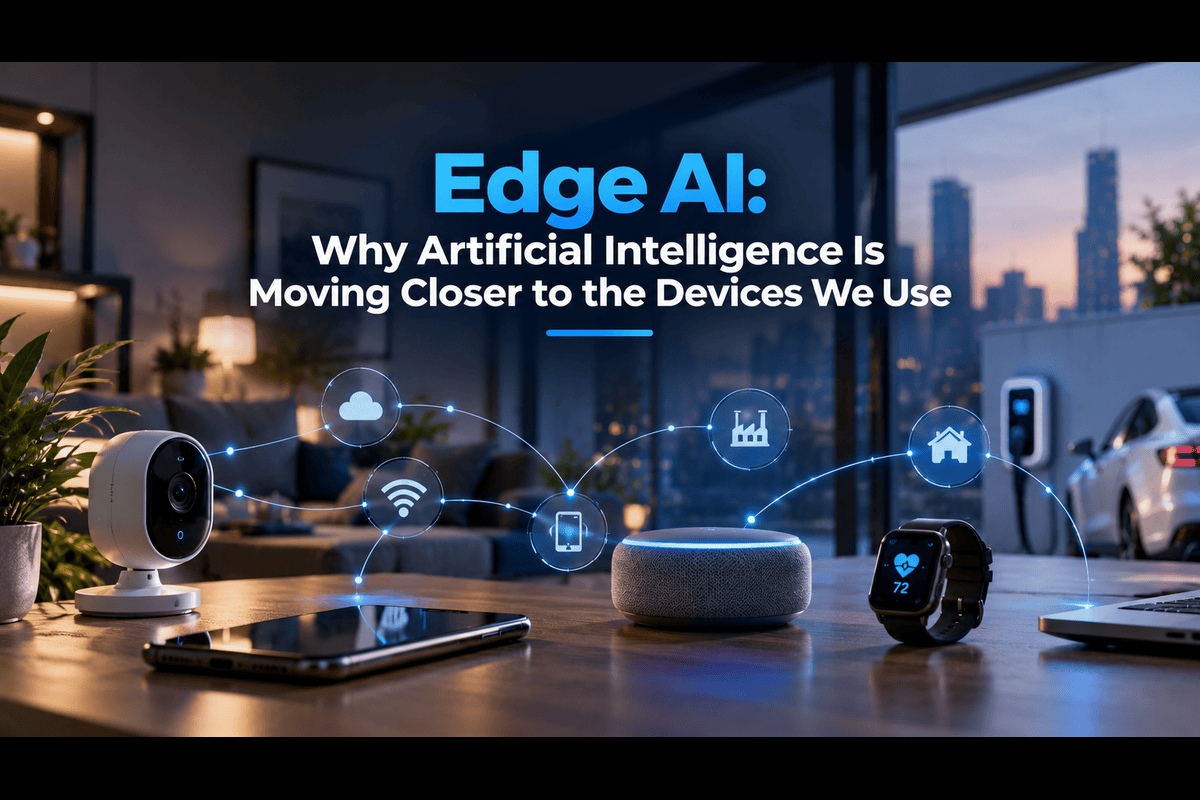
Artificial intelligence has traditionally depended heavily on cloud infrastructure.
A device collects information, sends it to a remote system, AI processes it, and the result is returned.
That model is now beginning to change.
AI is increasingly moving closer to where data is created.
From smartphones and laptops to industrial equipment, vehicles, cameras and other connected devices, more AI processing is taking place directly on or near the device.
This shift is commonly referred to as Edge AI or on-device AI.
Edge AI refers to running AI models or AI-enabled processing closer to the source of the data rather than sending every task to a centralized cloud environment.
A simple example is a smartphone using AI directly on the device to process an image, recognize speech or perform another intelligent task without sending all of the underlying data to a remote server.
The same concept can apply to enterprise environments.
Industrial equipment can analyze sensor information locally.
Security cameras can identify events without continuously sending raw video to the cloud.
Vehicles can process information from their surroundings with extremely low latency.
Enterprise devices can increasingly perform AI-assisted tasks without depending entirely on a remote AI service.
Deloitte identifies the rise of edge AI and on-device processing as a technology signal worth tracking as AI expands beyond traditional data-center environments. Deloitte
Several factors are driving the shift.
Some applications cannot afford to wait for information to travel to a remote cloud environment and back.
For applications involving vehicles, industrial systems, security or real-time decision-making, milliseconds can matter.
Processing information closer to the source can reduce that delay.
Not every piece of data needs to leave the device where it was created.
Keeping certain information locally can reduce the amount of sensitive data that needs to travel across networks.
This can be particularly relevant for applications involving personal, operational or confidential information.
Edge AI can reduce dependence on continuous connectivity.
If an intelligent device can process certain tasks locally, it may continue performing those functions even when connectivity to a central cloud service is limited.
The number of connected devices continues to grow.
Sending every piece of data generated by those devices to centralized infrastructure can create additional requirements for bandwidth, storage and processing.
Edge computing provides another way to distribute that workload.
The rise of Edge AI does not mean cloud computing is becoming irrelevant.
In many cases, the future will involve both.
A device may perform time-sensitive processing locally while sending selected information to the cloud for:
This creates a more distributed technology environment.
Instead of:
Device → Cloud → Device
the architecture can become:
Device → Edge Processing → Cloud
with different workloads handled at different levels.
The technology has applications across multiple industries.
Industrial equipment can analyze sensor data locally and identify potential problems before information reaches a central system.
AI-enabled cameras and devices can process information locally to support store operations and customer experiences.
Edge processing could support devices that need to analyze information quickly while limiting unnecessary movement of sensitive data.
Vehicles increasingly need to process information from cameras, sensors and other systems in real time.
Connected systems can use local intelligence to respond to occupancy, environmental conditions, security events and energy requirements.
Smartphones, laptops and other devices are increasingly being designed with hardware capable of handling AI workloads locally.
The result is a technology landscape where AI is no longer limited to large cloud platforms.
Edge AI also depends on changes in computing hardware.
Modern processors are increasingly incorporating capabilities designed specifically for AI workloads.
This includes dedicated AI accelerators and neural processing capabilities designed to perform certain AI tasks efficiently.
That matters because running AI locally requires a balance between:
Performance + Power Consumption + Heat + Cost + Model Size
A device cannot simply use unlimited computing resources.
It needs to deliver useful AI capabilities within its physical and energy constraints.
The cloud remains essential.
But its role may evolve.
Instead of processing every AI task centrally, cloud infrastructure can increasingly work together with edge devices.
The cloud can provide centralized intelligence and management, while edge systems handle tasks that benefit from proximity, speed or local processing.
This creates a more distributed AI architecture.
Deloitte's 2026 technology research similarly highlights the need to rethink infrastructure strategies as AI workloads expand, including the use of different computing environments for different workloads. Deloitte
The broader significance of Edge AI is not simply that devices are becoming smarter.
It is that intelligence is becoming distributed.
AI can exist across:
Cloud → Data Center → Edge → Device
This could change how businesses design applications, networks, security systems and infrastructure.
It also creates new challenges.
Organizations will need to consider:
As AI moves closer to the edge, managing thousands or millions of intelligent devices could become a major technology challenge.
Edge AI is also creating demand for skills that sit across multiple technology disciplines.
Professionals working in:
may increasingly find themselves working together.
This is another example of how emerging technology is breaking down traditional boundaries between technology roles.
The important development is not simply that devices are becoming capable of running AI.
It is that AI is moving from centralized systems into the environments where people, machines and data actually operate.
Cloud computing will remain a major part of the AI ecosystem.
But the next generation of AI applications may increasingly depend on a combination of cloud, edge infrastructure and intelligent devices.
The AI era may therefore become less about where the model lives and more about where intelligence needs to happen.
Edge AI is still developing, and adoption will vary significantly by industry and use case.
But the direction is becoming increasingly visible.
AI is moving beyond centralized software and into smartphones, computers, industrial systems, vehicles and other connected environments.
For businesses and technology professionals, understanding this shift could become increasingly important as the boundary between AI, cloud, hardware and connected devices continues to disappear.
Coolbuffs keeps you connected to the technology trends, skills and opportunities shaping the future of the industry.
By Entering your email address, you are agreeing to receive marketing emails from Coolbuffs Job Portal. You will receive the latest information about portal. Subscribe to receive our offers in preview.
Comments