
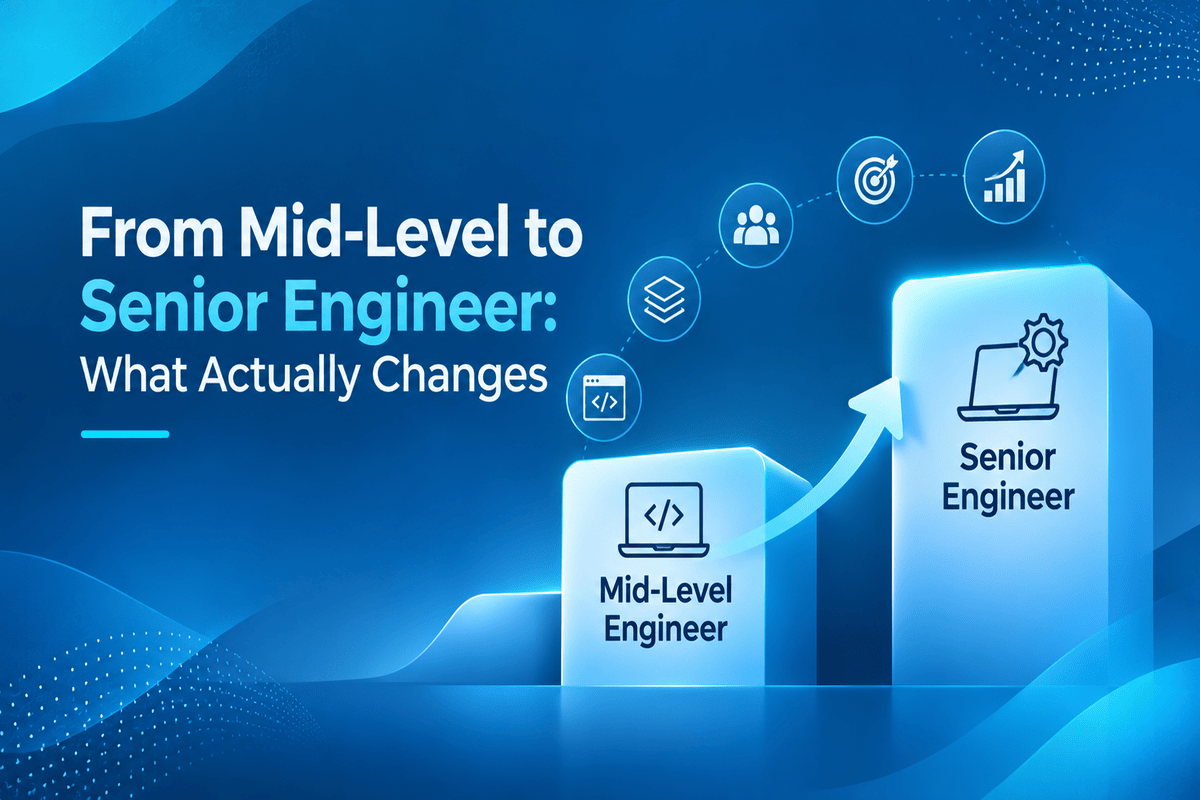
Plenty of capable engineers reach a point where their work is solid, their code reviews are clean, and their delivery is reliable and yet the senior title keeps going to someone else. It can feel arbitrary. It usually isn't. The skills that earn a promotion to mid-level are different from the ones that earn the next one, and many people only discover this when they are already stuck.
Understanding what actually changes at the senior level, and how to build visible evidence of it, is one of the most useful things a mid-level engineer can do for their career.
A mid-level engineer is typically trusted to take a well-defined task, implement it well, and ship it with little supervision. That is a real achievement, and it is the foundation everything else rests on. But it describes execution, and senior roles are largely judged on something broader: the quality of the decisions you make, the problems you choose to solve, and the effect you have on the people and systems around you.
This is also why time in role rarely works as a promotion strategy on its own. Years of experience matter only to the extent that they have produced a wider scope of impact, and that is something you can start building deliberately well before a title changes.
Mid-level work tends to be organized around tasks and features. Senior work is organized around outcomes and systems. Instead of asking how to implement a ticket, a senior engineer asks whether it is the right ticket, what it will affect elsewhere, and how it will hold up over time. Ownership extends beyond your own code to the reliability, maintainability, and direction of the area you are responsible for.
Senior engineers are expected to handle ambiguity: choosing between several workable approaches, explaining the trade-offs, and committing to a direction without perfect information. Technical depth still matters, but the visible difference is judgment - knowing when a simple solution is enough, when a risk is worth taking, and when to push back.
A strong mid-level engineer is highly productive. A senior engineer also makes the team around them more productive, through thoughtful code review, mentoring, clear documentation, and unblocking colleagues. A meaningful share of senior-level contribution never shows up in a commit history, which is exactly why it needs to be made visible.
Senior engineers regularly explain technical decisions to non-technical stakeholders, write design proposals, and align several people around a plan. The ability to make a clear case in writing and in conversation often matters as much as the technical solution itself.
As AI coding tools take over more routine implementation, the parts of the job that depend on judgment become more prominent, not less. Reviewing generated code critically, deciding what should be built and why, and catching subtle errors before they reach production are all skills that senior engineers are increasingly expected to demonstrate. Treat these tools as accelerators for your own thinking rather than a replacement for it.
Moving from mid-level to senior is less about doing more of the same work faster and more about changing the kind of work you do and the way you do it. Engineers who deliberately widen their scope, sharpen their judgment, and help others succeed tend to find that the title follows evidence they have already built.
Coolbuffs connects technology professionals with employers hiring across software engineering and beyond - explore current senior and growth-track opportunities when you are ready for your next step.
By Entering your email address, you are agreeing to receive marketing emails from Coolbuffs Job Portal. You will receive the latest information about portal. Subscribe to receive our offers in preview.
Comments